The 9 Percent: What 300 AI Futurists Actually Said
Over the last several weeks I pulled 300 videos off YouTube. Every futurist I could find talking about artificial intelligence. I watched them, I sorted them, I classified 257 of them by stance, and I took notes. I went looking for the good news because I could not find it anywhere else. This is the write-up of that case file. The video is above.
A correction first, because the show is built on checking things. At 17:50 in the video I say the sepsis result was a 70 percent relative reduction. It is 17 percent, which is what the slide on screen says at that exact moment. The absolute figure I gave, 1.9 percentage points, was right. COMPOSER, UC San Diego Health, npj Digital Medicine, January 23, 2024. I told you to check me, so I am starting with myself.
My bias, stated up front
I am 57. I spent 23 years carrying a badge in Los Angeles as a Big City Motor Cop with LAPD. I have sold real estate since 1998. I still flinch about health insurance, and I plan to be here another 500 years, which tells you something about my disposition.
Here is the sentence the whole thing rests on: I would rather be positive facing certain tragedy than negative headed toward abundance.
If I am wrong, I will have spent my last years hopeful. If the doomers are wrong, they will have spent theirs afraid of nothing. I know which of those two mistakes I would rather make.
But I am not going to ask you to feel your way there. I built cases for a living. This is not a pep talk. It is a case file, with citations you can check and a cross examination at the end where I put my own argument on the stand and try to break it.
Exhibit 1: the number
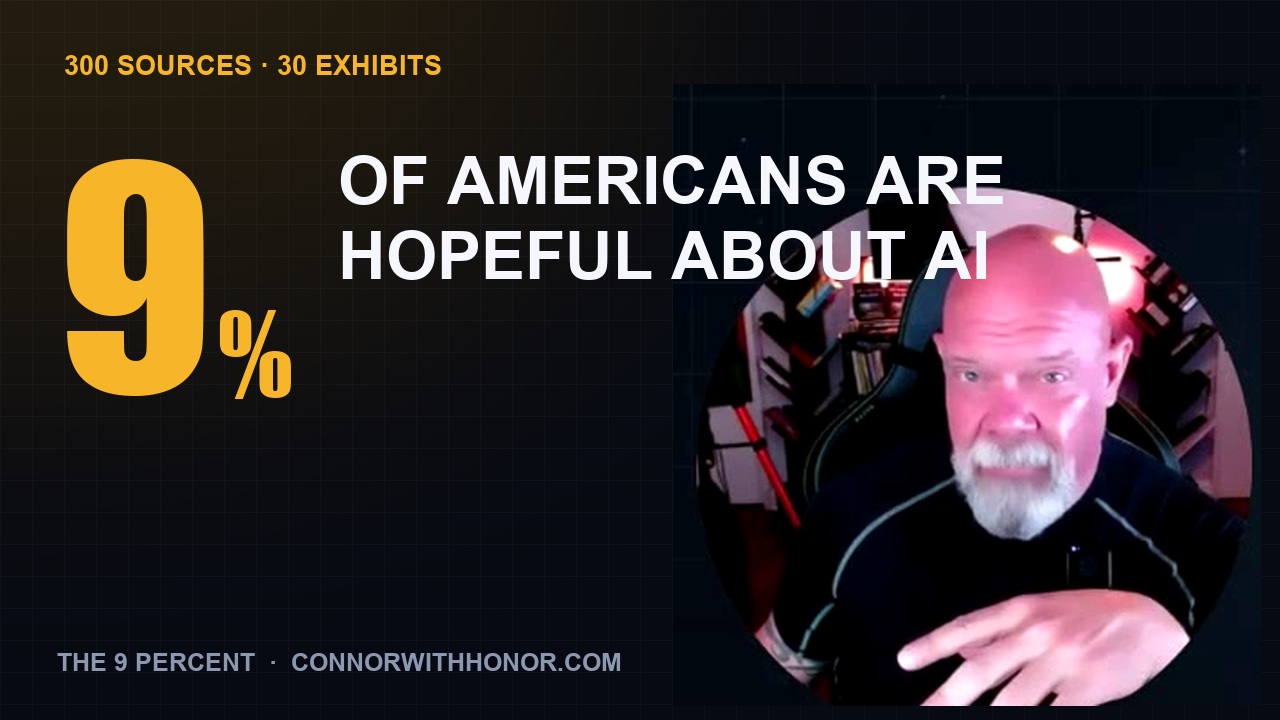
9 percent of American adults say they are more excited than concerned about artificial intelligence in their daily life. 52 percent say they are more concerned than excited.
Pew Research Center, 3,488 American adults, properly weighted national sample. Not a vibe. That is roughly 6 to 1, fear to hope.
Before I read a single study, I guessed the split in those 300 videos was about 10 percent good news and 90 percent bad. That was a cop's gut after watching a few hundred people talk about the future. Pew came back with nine. My gut was off by a point, and not because I am clairvoyant. When a thing is lopsided you can feel it without measuring it. You walk into a room and you know something is wrong before anybody tells you.
But the single number is not the story. The trend is.
In 2021, 37 percent of Americans were more concerned than excited. Today it is 52. Concern went up 15 points. That is bad, and it is not shocking. New technology makes people nervous. We have seen that movie.
Now look at the other line. In 2021, 18 percent were more excited than concerned. Today it is 9.
Hope did not slide. Hope got cut in half.
And here is the part that stopped me. That collapse happened during the exact five years when most people in history started actually using these tools. Usage went vertical. Enthusiasm halved. People are using AI more and liking it less.
It is worst among the young. For the first time on record, a majority of American adults under 30, 55 percent, are more concerned than excited, up from 31 percent in 2021. The generation using it most is the generation most afraid of it.
That is not a technology problem. The technology got better every one of those years. That is a story problem.
Where I was wrong, and I say it on camera
I said out loud, to people, before I checked anything, that those 300 videos would come back 10 percent hopeful and 90 percent doom.
So I checked. I had every source classified by stance. 257 got a clean classification.
| Stance | Sources | Share |
|---|---|---|
| Optimistic | 21 | 8.2% |
| Pessimistic | 23 | 8.9% |
| Neutral or mixed | 213 | 82.9% |
I was wrong. Doom and hope were almost dead even, 23 to 21. And the overwhelming majority of what people are actually publishing is neither. It is technical. It is somebody reviewing a model or arguing a thought experiment without picking a side.
So the material is not the problem. Which means the imbalance is happening somewhere between the material and your head, and that is a far more interesting finding than the one I went looking for.
Exhibit 3: the receipt
This is the most important number in the whole file and almost nobody has heard of it.
Researchers got hold of the Upworthy archive, where headlines were A/B tested at enormous scale. 22,743 randomized controlled trials. Over 100,000 headline variations. 370 million impressions. Published in Nature Human Behaviour in 2023.
The finding:
- Every negative word you add to a headline raises the click rate by 2.3 percent
- Every positive word you add lowers it by 1 percent
Read that again. Adding a positive word to a headline actively costs you readers.
I want to be precise about why this matters more than every media criticism you have ever heard. It is not a survey. It is not somebody's content analysis where they decided what counted as negative. These are 22,743 actual randomized experiments, the same standard used to approve drugs.
And here is the beautiful part. Upworthy was the *positivity* website. Their entire brand was uplifting news. Even there, in the lab of optimism, the machine paid better for fear.
A second study in Scientific Reports measured 95,000 articles against 579 million social media posts. Negative articles were 1.91 times more likely to be shared.
So let me say the quiet part. Nobody sat in a room and decided to scare you about AI. It is worse than that. Nobody had to. The incentive did it automatically, one A/B test at a time.
Two researchers, Roe and Perkins, hand-coded 671 AI headlines across seven British national newspapers. Human beings doing the reading, not a sentiment algorithm. The largest category, 37 percent, was impending danger. The smallest, 11 percent, was positive capability.
And here is the evidence against my own point, which the doom crowd never offers me. Two other studies using automated sentiment tools on the full text of AI articles find coverage is mostly neutral and slightly positive. If I hid those from you, somebody would find them and throw out everything else I said.
So here is the sharper version: fear does not dominate the total volume of AI writing. Fear dominates the headline. The share. The thumbnail. The part that makes it into your head, which is the only part that matters, because almost nobody reads past the headline.
The exhibits, all past tense
Everything in this section already happened. Not a promise, not a projection. Done, with a date and a journal.
A man got his voice back. Casey Harrell, 45, ALS. By 2023 his speech was gone; his wife could sometimes make out what he was trying to say. Researchers at UC Davis put electrodes in his brain and trained a model on his neural signals. 30 minutes of training, 99.6 percent accuracy on a 50 word vocabulary. Ninety more minutes, 90.2 percent on a 125,000 word vocabulary, which is the whole English language. Sustained accuracy with continued use, 97.5 percent. New England Journal of Medicine, August 14, 2024.
In 23 years of policing, the calls that never left me were not the violent ones. They were the ones where somebody needed to tell me something and could not. The stroke victim. The kid too scared to speak. The old man on his kitchen floor looking at me, trying to form a word. It is a specific kind of horror, watching a person locked inside themselves. A machine opened that door in 30 minutes.
A woman got her own voice back, not a synthetic one. Paralyzed by a brainstem stroke, a team at UCSF decoded her speech at 78 words per minute and synthesized it in her own voice, rebuilt from her wedding video. The lag was eight seconds, which lets you issue statements but not have a conversation. By April 2025, same team, same participant, under one second. Nature Neuroscience.
Then Stanford and Emory decoded imagined speech, words the participant never tried to say, at up to 74 percent accuracy. And here is the detail that tells you these are serious people: they built a mental password. The participant had to think a specific phrase to unlock the decoder, and it held with 98 percent reliability. They solved a piece of mind reading and their first move was to install a lock on it. The doom story says nobody is thinking about safety.
AlphaFold. A protein folds into a shape, and the shape decides whether it fights a virus or causes Alzheimer's. Working out one shape used to take a PhD student years. In roughly six years of global structural biology, working around the clock in every country, humanity solved about 200,000 structures. In July 2022, AlphaFold released 200 million. A thousand times more, in one release.
Then they did the thing that should have been the headline. They gave it away. Free, open, no license, no paywall. Over 3 million researchers in more than 190 countries use it, and more than a million of those users are in low and middle income countries. A scientist in Lagos has the same structural biology toolkit as one at Harvard. Hassabis and Jumper took the 2024 Nobel in chemistry for it, shared with David Baker.
Here is my question for the doom crowd. If a group of people solve a 60 year old scientific problem and then hand it to the entire planet for free, what exactly is the theory of their character?
Mammography, three countries, three designs, same direction. In the Lancet, January 2026: with AI, 81 percent of cancers caught at screening against 74 without. 27 percent fewer aggressive subtypes slipping through. 21 percent fewer large tumors. And it did not do it by flagging everything: false positives barely moved, 1.5 percent against 1.4. Germany ran a bigger one, 463,094 women, Nature Medicine, January 2025: detection up 17.6 percent with the recall rate going down. Denmark implemented nationally, detection from 70 to 82 per 10,000, false positives from 2.39 to 1.63 percent, radiologist workload down a third.
Sepsis. It kills more Americans than breast cancer, prostate cancer and opioid overdose combined, and the entire game is time. UC San Diego turned on a system called COMPOSER in its emergency departments. Across 6,217 septic patients, in-hospital mortality fell 1.9 percentage points in absolute terms, a 17 percent relative reduction. npj Digital Medicine, January 23, 2024.
I keep saying that one differently from the others on purpose. 97 percent accuracy is a score. Seventeen percent fewer deaths is a hallway. It is a family in a waiting room getting the other conversation. I ran calls where we were four minutes too late. You do not forget the four minutes.
Antibiotics, invented rather than found. In 2020 MIT trained a model on about 2,500 molecules and turned it loose on over 100 million. In three days it found halicin, which cleared a drug-resistant *Acinetobacter baumannii* infection in mice. In 2023, Nature: 12,076,365 compounds evaluated, surfacing a new structural class against MRSA and vancomycin-resistant enterococci. By August 2025 the model was not searching, it was inventing: over 36 million compounds generated atom by atom, molecules that had never existed, two of which cleared drug-resistant infections in mice.
And a drug. Rentosertib, from Insilico Medicine. AI identified the biological target, then a generative model designed the molecule to hit it. The disease is idiopathic pulmonary fibrosis, where your lungs scar until you cannot breathe and median survival is three to five years. Phase 2a in Nature Medicine, June 2025: at the 60mg dose, lung capacity improved 98 milliliters while placebo lost 20, a 119 milliliter separation in a disease that only goes one direction. Phase 3 opened July 2025 across 47 centers. Industry standard from start to preclinical candidate is two and a half to four years. Insilico's average across 22 candidates is 12 to 18 months.
Then I cross examine my own case
This is where most optimism content ends, and where mine has to earn its keep.
In 23 years of building cases I learned one thing that made me better than the guys who did not learn it. You attack your own case first, hard and in private, before the defense does it in public. Whatever the hole is, somebody will find it. The difference between a conviction and a mistrial is whether you found it first.
I start with my own star witness. In January 2025, Demis Hassabis said AI-designed drugs from Isomorphic Labs would be in clinical trials by the end of 2025. In January 2026 at Davos, he moved it to the end of 2026. A full year. As of April, the company president described human trials as "the next big milestone." They have raised billions and have deals with Novartis, Eli Lilly and Johnson and Johnson. They do not have a drug in a human being. So when somebody tells you Isomorphic has drugs in trials, that is not true, and I am telling you that even though it hurts my argument.
Then Dario Amodei, who restated the five to ten year cure claim last month and, in the same statement, conceded that the industry including his own company "deserves criticism for not yet delivering on the biggest promises to benefit the world." The CEO said that, not a critic.
The pattern is clear and I will not pretend otherwise. These men are consistently right about direction and consistently optimistic about speed.
Then the strongest punch against my whole case. Dr. Eric Topol, cardiologist, founder of the Scripps Research Translational Institute, a man who has spent his career arguing technology will transform medicine. On curing all disease in a decade: "diabetes, Alzheimer's, heart disease. We don't have any cure for those common diseases. There's no precedent for that." He called the projections wildly off base.
Lior Pachter at Caltech adds the one that really lands: we do not even know what all the human diseases are.
And Gary Marcus at NYU makes the argument I think is unanswerable. You cannot compress a clinical trial. You can find the target in a month and design the molecule in a week, and then you have to give it to human beings and wait years to see if it kills them. Biology runs on biological time.
I do not have a good rebuttal to that. Neither does anybody else.
The 47 percent that never happened
In 2013, Frey and Osborne at Oxford estimated that 47 percent of total US employment was at high risk of computerization, perhaps a decade or two out. That number went around the world. It was on every magazine cover.
Thirteen years later, August 2026, unemployment is 4.1 percent.
Be fair to those researchers. They said jobs were at risk of automation. They did not say those jobs would disappear. The press turned it into "47 percent of jobs are going to vanish." So the lesson is not that the academics were fools. The lesson is what happens between a careful paper and a headline, which is exactly what the Upworthy trials proved with 370 million impressions.
There is a better example. Bank tellers. From 1988 to 2004, ATMs cut tellers per urban branch from 20 to 13. Everybody said tellers were finished. Banks then opened 43 percent more urban branches, because each one got cheaper to run. Total teller employment did not fall. That is the IMF, not a tech blog.
The machine made the job cheaper, and cheaper meant more of them.
The fear I actually respect
It is not killer robots. It is the bill.
65 percent of Americans say people like them will be left behind and not benefit from this. 71 percent of Britons. That is the 2026 Edelman Trust Barometer, and I get it. When somebody on a stage in a black turtleneck tells me they are going to cure aging, my first thought is not *wonderful*. It is *how much, and is it in network.* That is not cynicism. That is a 57 year old who has read a benefits summary.
But look at the other numbers on that slide. China, 36 percent worried about being left behind. Brazil, 33. Same technology, half the despair. 83 percent of Chinese respondents think AI's benefits outweigh its drawbacks, against 39 percent in the United States. A 40 point gap. Globally, optimism is rising, from 52 percent in 2022 to 59 percent last year, while American concern climbs.
We are not leading the world in caution. We are diverging from it.
So the left behind fear is real and worth taking seriously, but it is not a fact about the technology. It is a fact about how much Americans currently trust that anything good will be shared with them, which is a fair thing to distrust.
The exhibit that changed my mind
Eric Brynjolfsson at Stanford with Danielle Li and Lindsey Raymond at MIT studied 5,179 real customer support agents at a real company using an AI assistant.
- Average productivity gain: 14 percent
- Gain for the novice and low-skilled worker: 34 percent
The tool helped the person with the least experience two and a half times more than it helped the veteran.
Think about what that is. Almost every technology of the last 40 years widened the gap. It made the guy at the top faster. This one made the guy at the bottom able to compete.
The World Bank ran an after-school AI tutoring program in Nigeria. Six weeks, students gained 0.3 standard deviations, which the World Bank described as nearly two years of typical learning. It outperformed 80 percent of every education intervention in their database of randomized trials in developing countries. And the girls gained most.
And AlphaFold, again: over a million users in low and middle income countries, at the same price as Harvard pays. Free.
Where it has actually been measured, this thing lifts the person with the least, the most. That is my whole bet.
The verdict
It is not what either side wants.
The optimists are wrong about the calendar. Hassabis left a year on his own drug trials. Amodei admits the industry has not delivered. Every timeline in this file is probably too fast.
The doomers are wrong about the direction.
Being wrong about *when* is a scheduling error. Being wrong about *which way* is a category error.
If Hassabis is five years late on curing disease, we cure disease in 2040 instead of 2035, and I am 71 instead of 66. I will take it and say thank you. But if the doomers are right about direction, none of the scheduling matters at all.
Look at what direction actually looks like when you measure it instead of feeling it. 200 million protein structures. A man with ALS talking at 97.5 percent. 17 percent fewer sepsis deaths. 27 percent fewer aggressive cancers found too late. 140 kilometres closer on a hurricane track five days out.
Every arrow in this file points the same way. The only argument is about speed.
Why a retired motor cop spent 300 hours on this
When I was working, I could tell you inside about four seconds which officers would have a long career and which would burn out at eight years. It had nothing to do with courage. The burnouts were often braver than I was.
It was what they expected to find when they walked up to the car. The guy who expected a threat found threats. He was not wrong that danger is real. I have the scars. But his expectation narrowed him to one thing and he stopped seeing everything else.
The other guy stayed just as alert. Same vest, same street, same shift. He walked up expecting a human being, and he saw one. And a lot of calls that should have gone bad, did not. Even with genuinely dangerous people, being treated like a person was sometimes the reason everybody went home.
I am not telling you there is no danger in artificial intelligence. Of course there is. The people building it say so louder than the critics do, which is a strange fact nobody wants to sit with.
I am telling you that walking up to the next 20 years expecting a threat will make you smaller, slower, and worse at seeing what is actually in front of you.
I would rather be positive facing certain tragedy than negative headed toward abundance. And based on these 30 exhibits, I do not think we are facing tragedy.
I am looking for the other 9 percent
If you build in this space, research it, fund it, or you are a doctor watching one of these tools work in your own hospital, I want to talk to you. If you are just a person who refuses to be afraid, same.
I am not selling anything. Book time and come on the show. It is free. We will just talk it out.
Every exhibit in the video carries its source on the slide. Go check me. If something is wrong, tell me and I will correct it on camera, the way I corrected myself twice inside this one.
AI for everyone. Not just the wealthy.
I'm Connor with Honor. Be safe out there.
Common questions
How many Americans are actually hopeful about AI?
9 percent of American adults say they are more excited than concerned about artificial intelligence. 52 percent say they are more concerned than excited. That is Pew Research Center, 3,488 adults. In 2021 the hopeful figure was 18 percent, so it halved during the exact five years most people started actually using these tools.
Is AI news coverage actually negative?
The material itself is close to balanced. Of 257 sources classified by stance, 21 were optimistic, 23 pessimistic and 213 neutral or mixed. The imbalance happens between the material and your head. The Upworthy archive shows the mechanism: 22,743 randomized controlled trials and 370 million impressions, where every negative word added to a headline raises click rate 2.3 percent and every positive word lowers it 1 percent.
What has AI already done in medicine, past tense?
A man with ALS speaking again at 97.5 percent sustained accuracy on a 125,000 word vocabulary. 200 million protein structures released free after humanity had solved 200,000 in six years. Mammography catching 81 percent of cancers against 74 with false positives unchanged. Sepsis mortality down 17 percent relative across 6,217 patients. A drug found by AI and designed by AI now in phase 3.
What is the strongest argument against AI optimism?
Gary Marcus at NYU makes the one I cannot answer. You cannot compress a clinical trial. You can find the target in a month and design the molecule in a week, then you have to give it to human beings and wait years to see if it kills them. Biology runs on biological time.
Does AI help the top or the bottom of the skill range?
The bottom, where it has been measured. Brynjolfsson at Stanford with Li and Raymond at MIT studied 5,179 real customer support agents. Average productivity gain 14 percent. Gain for the novice and low-skilled worker, 34 percent. It helped the least experienced person two and a half times more than the veteran.
Connor T. MacIvor · CalDRE #01238257 · Sync Brokerage, Inc. · DRE #02031490